



The importance of efficiency in commercial and industrial energy storage systems
Company Dynamic
December 25, 2025


The efficiency of industrial and commercial energy storage systems is the core lifeline that determines their economic value and market competitiveness, and is directly related to the payback cycle and full life cycle benefits. The following analyzes the key role of efficiency from three dimensions: technology, economy and policy, and combines empirical data to illustrate the chain value upgrading brought by every 1% increase in efficiency:

First,The “exponential relationship” between efficiency and economics
1. Sensitive leverage on cost per kilowatt-hour (LCOS) 1% efficiency improvement → 2%-3% LCOS reduction
2. Shorter payback
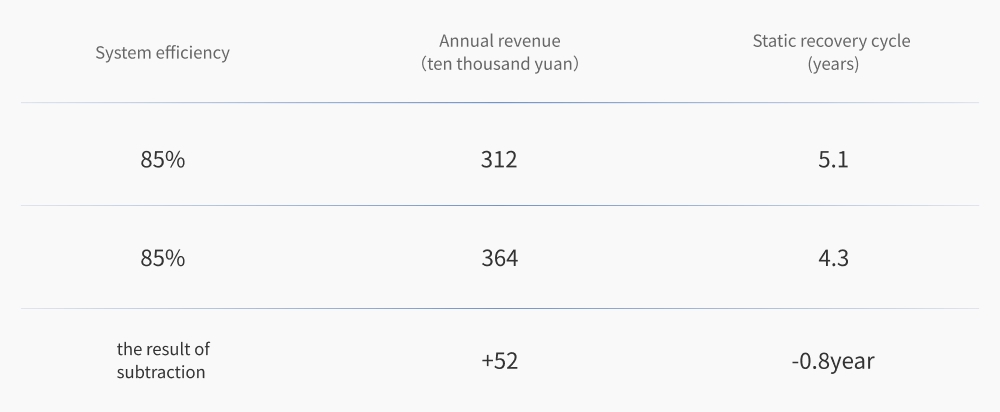
*Note: Calculated on the basis of a 10MW system investment of 16 million yuan and a peak-to-valley spread of 0.8 yuan/kWh*.
Second: Technical Value: How Efficiency Penetrates the Entire System Chain
1. “Black Hole” Distribution of Energy Loss
Loss Composition of Typical Industrial and Commercial Systems:
PCS Conversion Loss (4%-6%)
BMS Standby Energy Consumption (1%-2%)
Inter-cluster Circulation Loss (1%-3%)
Energy Consumption of Temperature Control System (3%-8%)
Energy Loss of Inefficient System Inefficient system energy loss up to 20%, equivalent to 400,000 kWh of electricity lost annually (10MW system)
electricity lost annually (10MW system)
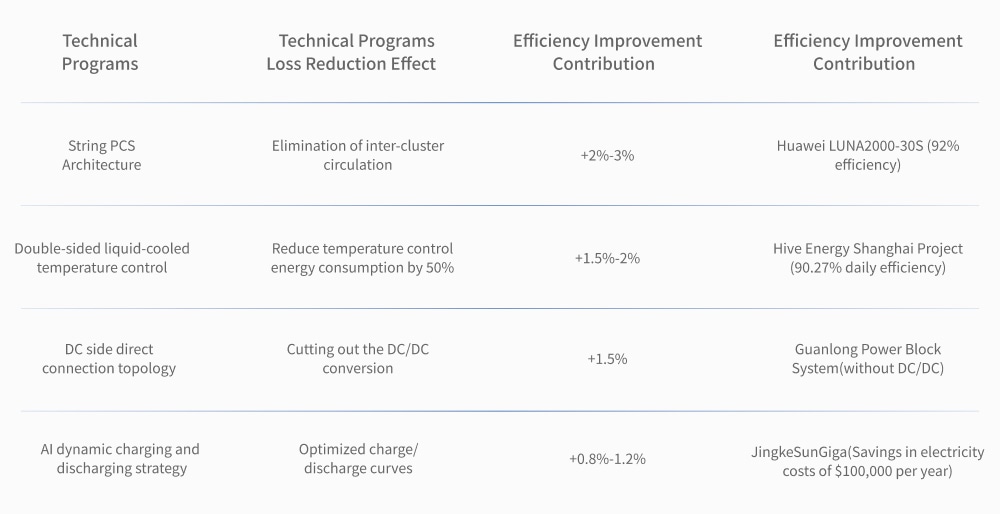
2.Precise sniping of attrition by efficient technology
Loss Composition of Typical Industrial and Commercial Systems:
PCS Conversion Loss (4%-6%)
BMS Standby Energy Consumption (1%-2%)
Inter-cluster Circulation Loss (1%-3%)
Energy Consumption of Temperature Control System (3%-8%)
Energy Loss of Inefficient System Inefficient system energy loss up to 20%, equivalent to 400,000 kWh of electricity lost annually (10MW system)
electricity lost annually (10MW system)
Third, the pass of policy and market access
1. Efficiency threshold becomes a hard screening standard
China: the efficiency of new energy storage system is mandatory ≥85% in 2025 (Energy Bureau’s “Code of Management for New Energy Storage Projects”), and Guangdong subsidizes ≥90% of projects with RMB 0.1/kWh;
EU: the Battery and Waste Regulation requires that the carbon footprint of energy storage systems be ≤58kgCO₂/kWh, and inefficient systems exceed the carbon emission standard due to more charging and discharging cycles; Saudi Arabia: 8GWh tendering projects explicitly require system efficiency ≥88% or lose the bidding qualification. Low-efficiency systems exceed the carbon footprint due to more charging and discharging cycles;
Saudi Arabia: 8GWh bidding program explicitly requires that the system efficiency ≥ 88%, or lose bidding eligibility.
2. Tie between efficiency and carbon footprint
Every 1% decrease in system efficiency → 2.3% increase in number of charge/discharge cycles to compensate → 4.1kgCO₂/kWh increase in carbon footprint.
*Case: An 85% efficiency system has a carbon footprint of 62kgCO₂/kWh and cannot enter the EU market.
Fourth,The “hidden cost bomb” of inefficient system
1. Accelerating effect of life depreciation
The working temperature of electric core rises 5℃ → 30% cycle life decay (Argonne lab data)
Cold system at 35℃ ring temperature core temperature difference of 8℃, local high temperature area life plummeted;
Liquid cooling system temperature difference is controlled within ±2℃, life consistency increased by 40%. 40%.
2. Exponential amplification of safety risk
Every 10℃ increase in temperature → 200% increase in thermal runaway risk (UL9540A test conclusion)
Inefficient temperature control system in a high temperature environment to increase the failure rate by 3 times, fire insurance premiums increased by 50%.


